Overview
QAVACH CBOM answers the question a migration lead actually has. Scanners find thousands of cryptographic findings. QAVACH works out which ones belong to the organisation, what to fix first, and what can be left alone.
It was built for the Smart India Hackathon 2026 (problem statement 26164, NTRO). It is a different product from the QAVACH PQC e-Governance architecture: this one is an inventory and migration planner, not a signing pipeline.
The problem
India’s DST Task Force under the National Quantum Mission sets migration deadlines for critical infrastructure (CII) and enterprises. Every migration guide starts with the same step: inventory your cryptography first.
Scanners exist, but they produce undifferentiated output. One real scan of 21,224 assets came back as CRITICAL 13, HIGH 10,788, MEDIUM 0, LOW 2, NONE 10,421. That is not a plan.
What it does
- Discovers across source code, dependencies, container images, live TLS endpoints, certificate stores, cloud KMS and HSM configuration. Discovery is delegated to open-source scanners (cdxgen, CBOMkit, CBOMkit-theia, Syft, Opengrep). The TLS, certificate, cloud and HSM collectors were written in-house.
- Reconciles conflicting scanner output into one canonical inventory. The same RSA-2048 key found by four tools in four places becomes one asset with four occurrences.
- Contextualises each asset with the facts scanners cannot see: the owning system, its criticality, how long its data must stay confidential, and whether it faces the internet.
- Places every finding in the organisation. The organisation is drawn once (you, vendors, hosts, certificate authorities, upstream projects). A finding is then yours to fix, a vendor’s to chase, or a public CA’s to leave alone.
- Aligns with CERT-In’s BOM guideline v2.0: a schema-valid CycloneDX 1.7 CBOM, a check against the guideline’s minimum elements, and VEX statements (not affected, affected, fixed) exported as CycloneDX VEX.
- Scores with Mosca’s inequality applied per cryptographic function class, inside CARAF’s five-dimension risk framework. Each asset gets one of four outcomes: Migrate, Compensating control, Accept, or Phase out.
- Sequences the work into a dependency-ordered migration roadmap. It respects trust anchors, protocol peers, hardware gates and the reader-before-writer rule, and flags where a cycle needs a hybrid bridge.
Design decisions
It only ranks what you can change. Every asset carries a Migration Authority: yours, a vendor’s, a public trust anchor’s, or gated on a regulator. A public CA found inside a downloaded installer is inventoried and then left alone.
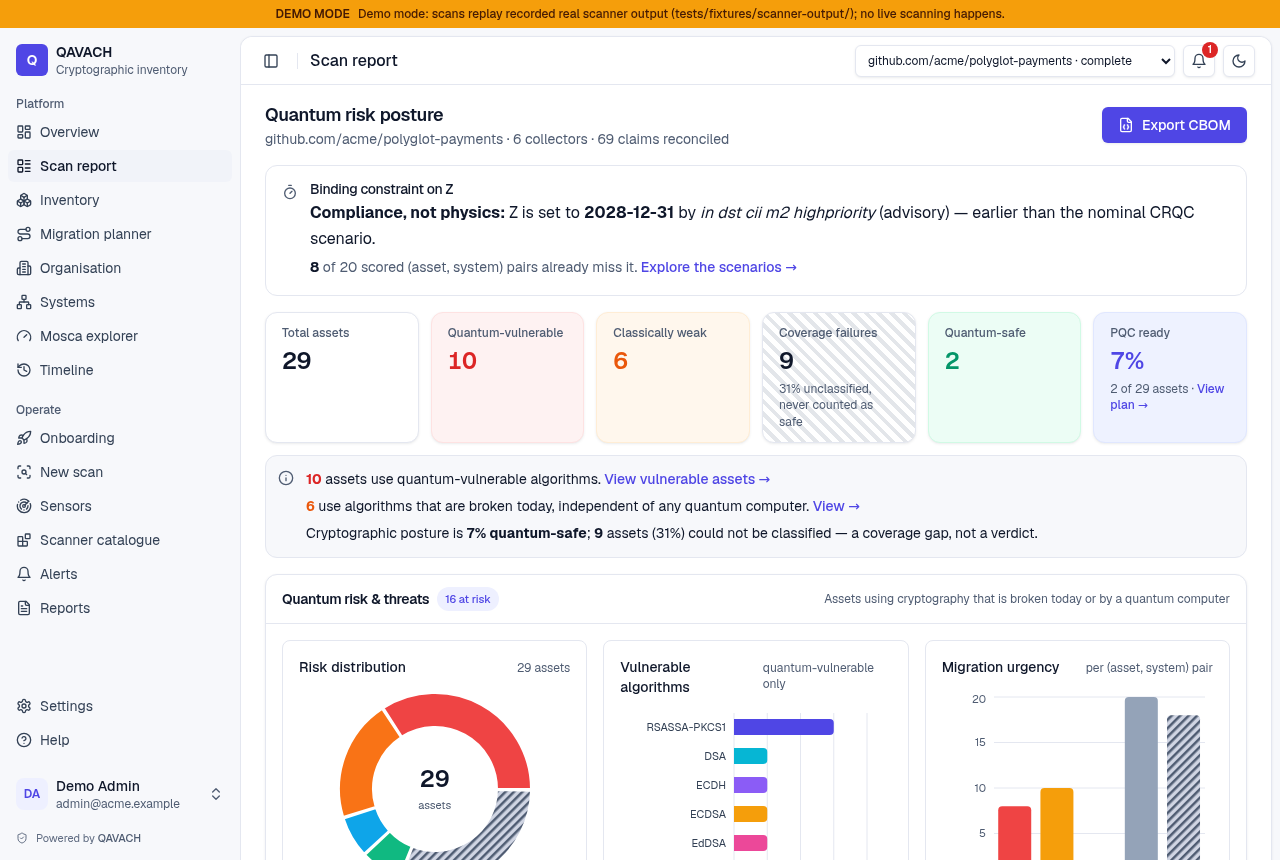
Unknown is never green. An algorithm that cannot be resolved, or a key whose size is unknown, is reported as a coverage failure. It is counted separately and never allowed into a safe total.
Four separate finding classes. QUANTUM_VULNERABLE (Shor-breakable asymmetric), CLASSICAL_WEAK (MD5, SHA-1, 3DES: broken today, not by quantum), GROVER_AFFECTED (AES-128: informational, never an urgent item), and QUANTUM_SAFE.
Shelf life is per function. A 90-day TLS certificate and an offline root CA can use the same algorithm and key size and still have very different urgency. Root CAs and firmware signing keys rank where they belong.
The regulatory date can bind before quantum does. For an Indian CII operator the binding constraint is often the December 2028 regulatory date. QAVACH computes min(Z_scenario, regulatory_deadline) and reports which one bound. Z is a configurable, cited policy input.
Every number is reproducible. The same inputs and policy snapshot always produce the same register. No LLM is in the scoring path. Each policy constant cites a primary source.
“Accept” and “Phase out” are first-class outcomes. A finite budget needs a principled way to say “leave this alone”.
What it is not
- Not a crypto scanner. Discovery is deliberately delegated.
- Not an HSM inventory tool. v1 detects PKCS#11 evidence and flags the unresolved crypto boundary. Live slot enumeration needs vendor credentials and hardware.
- Not a remediation tool. It plans. It does not open pull requests or rotate keys.
- No accuracy claims yet. Precision and recall against hand-labelled ground truth is a planned task.
Standards tracked
| Standard | Status (as of 2026-09) |
|---|---|
| ML-KEM (FIPS 203), ML-DSA (FIPS 204), SLH-DSA (FIPS 205) | Final, published 2024-08-13 |
| LMS / XMSS (SP 800-208) | Final |
| HQC | Selected 2025-03-11, standard not yet published |
| FN-DSA (FIPS 206) | In development |
Policy anchors include the DST/NQM quantum-safe roadmap (May 2026), SEBI CSCRF crypto-asset inventory, CERT-In’s SBOM/QBOM/CBOM technical guideline v2.0, NIST IR 8547, and NSA CNSA 2.0 (applicability-scoped).
Stack
- Backend: Python 3.12, FastAPI, RQ workers, PostgreSQL 16
- Frontend: React 18, TypeScript, Vite, Cytoscape.js
- Isolation: scanners run as sandboxed containers (Podman by default, Docker optional), never linked or run in-process
- Output: CycloneDX 1.7 CBOM (1.6 downgrade export), a separate Crypto Risk Register keyed by CBOM
bom-ref, and PDF reports. Exports are signed with ML-DSA. - Security: per-job sandboxing with no network by default, build resolution off by default, SSRF controls on network targets
Screens
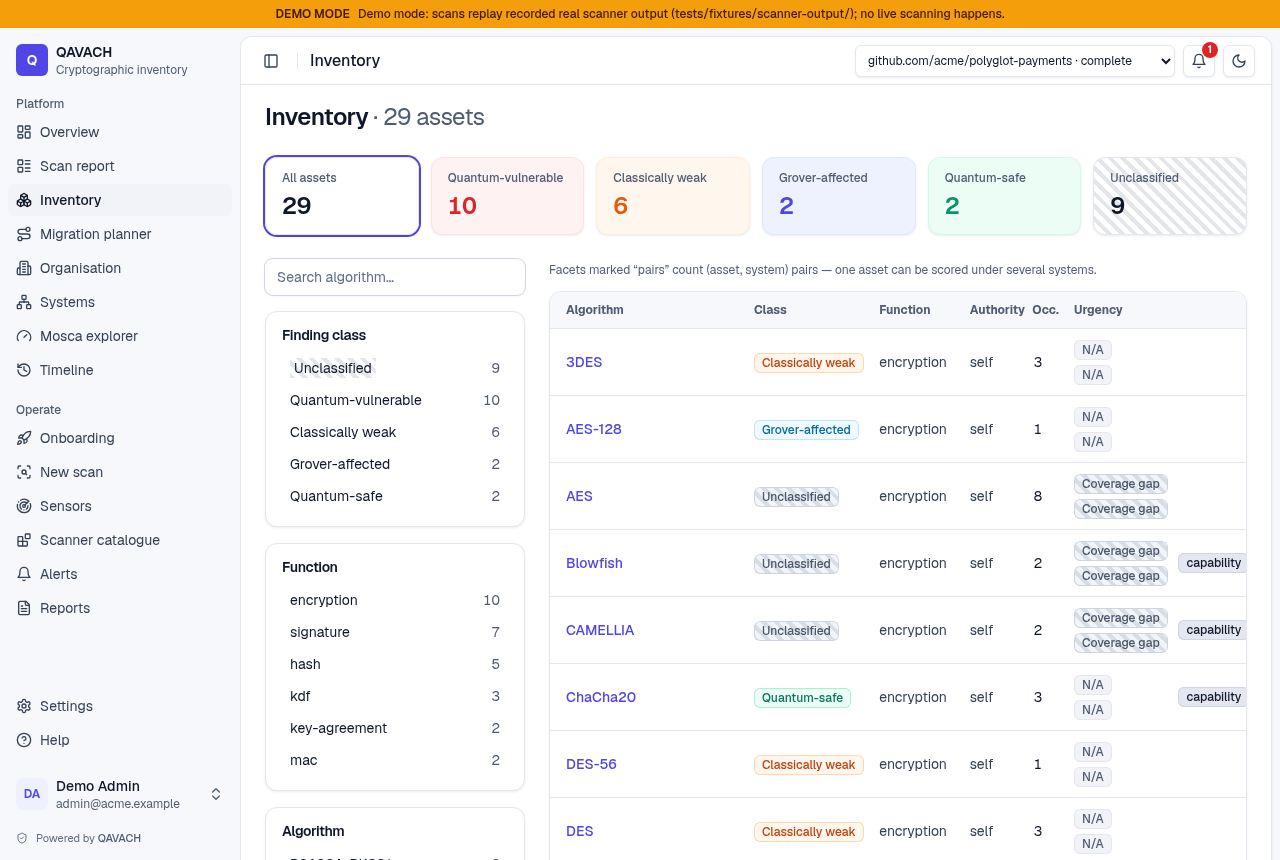
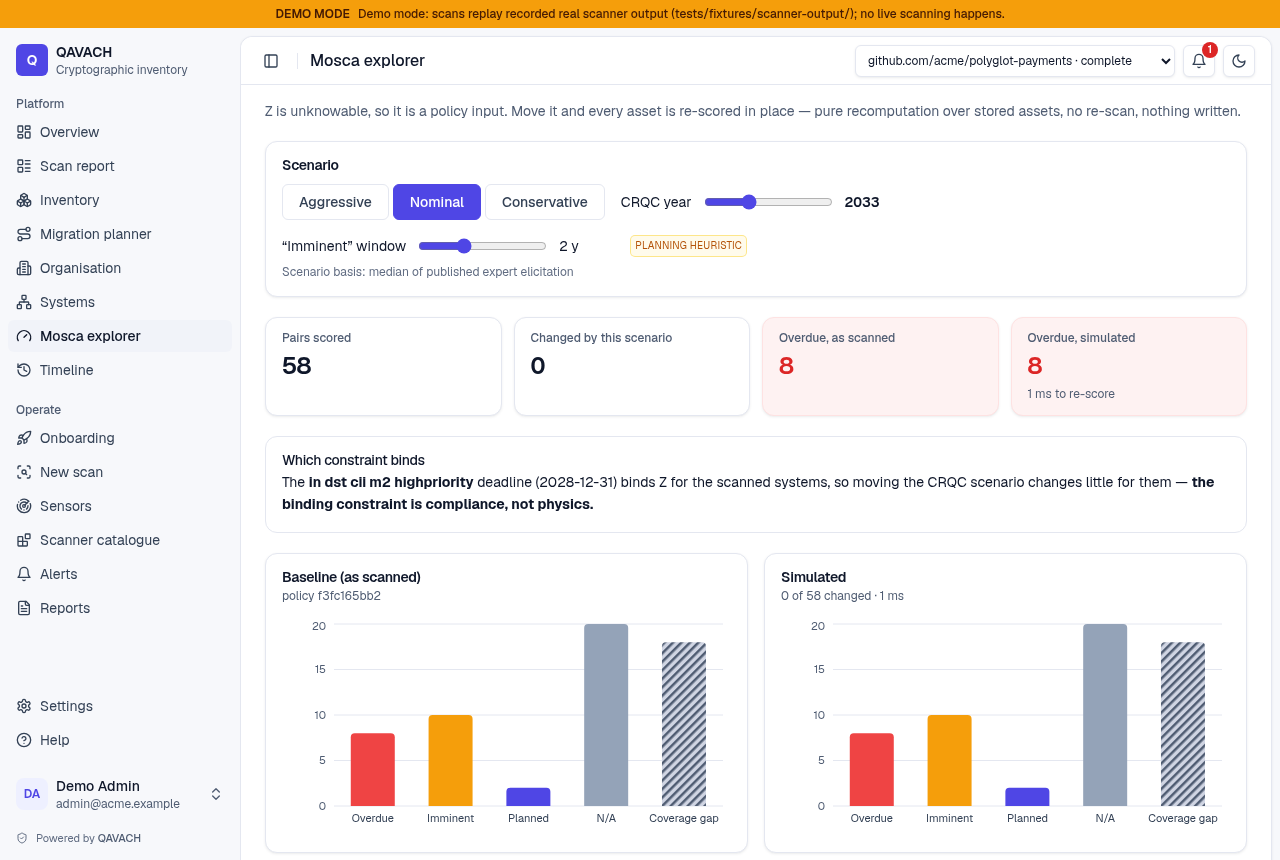
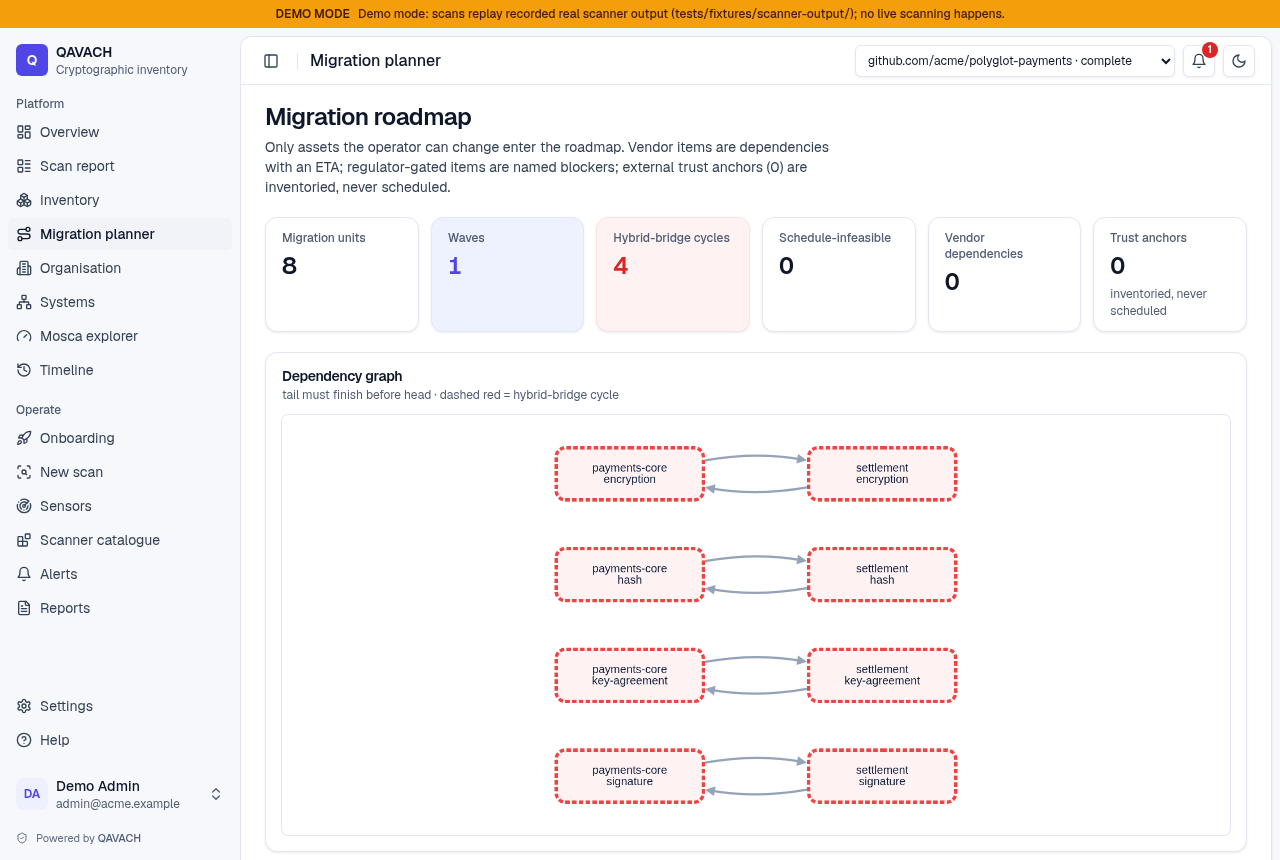
The screens come from the built-in demo mode, which replays recorded scanner output from a sample organisation. No live scanning happens in demo mode.